
Reading the cards
Tarot as a route to self-knowledge

Today I want to share some thoughts on one of the practices I use to help me stay grounded and in touch with my inner self: Tarot. This isn’t an introduction to its history or general practice; what I want to do is run through how I approach a Tarot reading in order to get the most helpful response. I’ll also share my latest Tarot spread and what it means for me in practical terms; in other words, how it helps me focus and make real choices & changes in my life.
Tarot is sometimes thought of in disparaging terms, as nothing more than ‘woo-woo’ fortune telling used by quacks to deceive the simple. However, this is to do it a disservice: Tarot can be a powerful tool that helps individuals tune in to their subconscious and access their intuition. This can be particularly helpful when we are experiencing mental overwhelm, when we have too much information swirling around in our logical brains and we don’t know what to think. The images on the cards speak to us in a way words do not, and their inherent symbolism connects us with what C. G. Jung termed the ‘collective unconscious’ (shared mental concepts such as archetypes), allowing us to feel an instinctual/gut response to the issue at hand. This does not necessarily override our rational response, but can usefully complement it, giving us a richer, more fully formed view of our situation.
Decks and symbolism
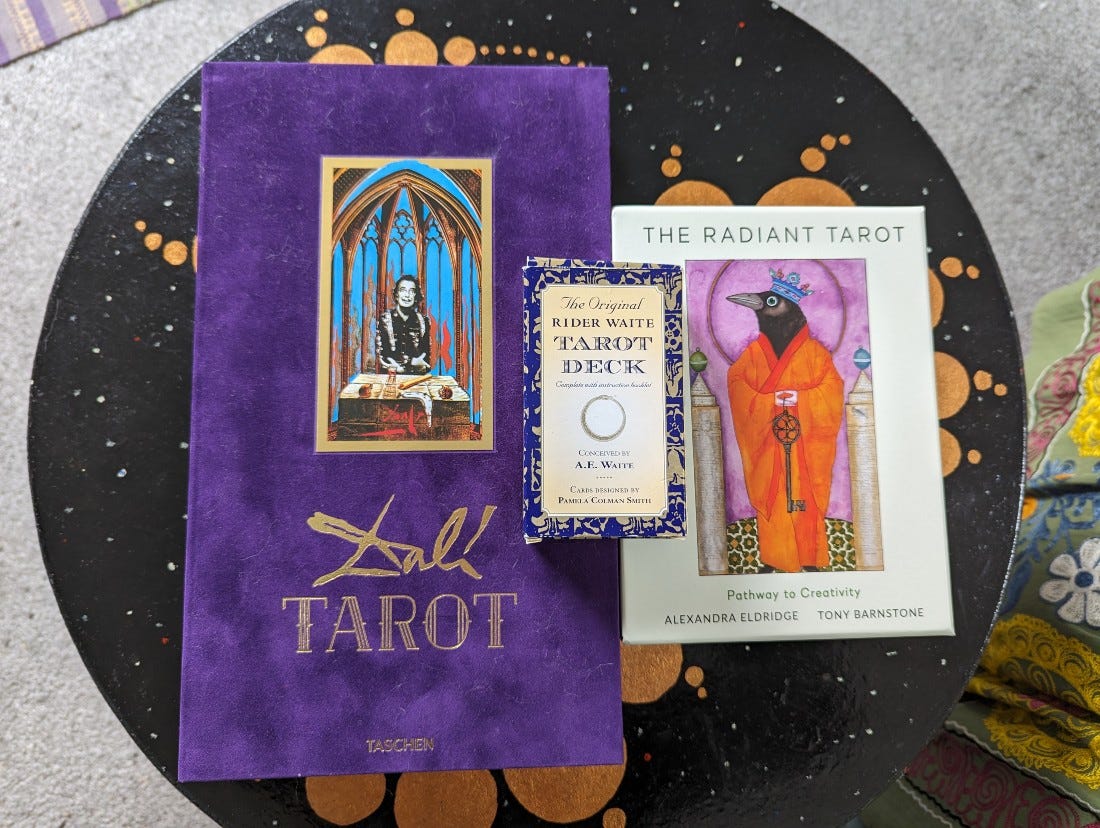
One of the most famous Tarot decks is the Rider–Waite–Smith deck, devised by academic & mystic A. E. Waite and illustrated by Pamela Colman Smith. This is the main deck I use, but I also own the Dalí Tarot (illustrated by surrealist artist Salvador Dalí) and another called the Radiant Tarot (aimed especially at people looking to develop their creative practice). Somewhat confusingly, there can be slight differences in detail between decks as to what the individual cards mean; this may be why some Tarot readers prefer to rely on a personal interpretation of what a card says to them rather than insist on its ‘true’ meaning. However, I believe the collective symbolism is an important factor in connecting me with the wider world, so I combine ‘official’ meanings (distilled from a range of sources) with my own gut response for a fuller picture. (If I have a strong sense that a particular card’s meaning is wrong for me at a given moment, I take note of that, rather than what it’s ‘supposed’ to mean – but I also try to determine whether I’m merely resisting a message I don’t want to acknowledge, or if the meaning applies in another part of my life that I haven’t yet considered.)
Spreads and questions
Tarot cards are used in spreads to shed light on a wide range of situations, and in my view the most vital part of the process is to come up with the right question(s) in the first place. If you don’t have clarity on what you’re asking, the answer will be similarly vague, and if your question is too rigid (e.g. ‘either/or’), the answer may be too limiting to be helpful; for instance, if it’s not the answer you want, that can be quite demoralising and cause you to feel deprived of agency. It’s important that the cards are given the opportunity to expand on elements of your situation, giving you considerations to reflect on as you deliberate your response.
For example:
Rather than ‘Should I take this job?’, try ‘What factors do I need to take into account when considering this job offer?’
Rather than ‘Is my relationship going to work out?’, try ‘What are the different ways I could respond to what’s going on in my relationship at the moment?’
Rather than ‘What should I do with my life?’, try ‘What are my most important values at the moment?’
Spreads can contain as little as one card (some people use this as a simple form of daily guidance), and there are many more complicated ones: the Celtic Cross, for instance, features ten cards, each representing a different aspect of a question (unconscious drivers, external influences, hopes & fears etc). These detailed spreads can be useful if you really want to dig deep into a situation, but they can take a lot of time to evaluate, so I don’t tend to use them on a regular basis. I have found that a three-card spread is a good middling choice for a weekly reading; and of course, what the cards represent can vary depending on what you’re hoping to gain insight on.
Examples of three-card spreads include:
Past, present and future
Body, mind and spirit
You, your relationship and your partner
There is vastly more that can be learnt about interpreting a Tarot spread, such as by interrogating how the different cards relate to each other (numerology of the card numbers, relationships between any human figures on the cards, relationships between symbols and so on) – but you don’t need to make it any more complicated than you want it to be. I personally use a very simple three-card spread, and interpret each card individually based on its position (i.e. what aspect of the situation it represents), the ‘official’ symbolic meaning, and my own feelings about how that resonates for me.
The one thing I would like to stress is the importance of your own agency. As far as I am concerned, a Tarot reading should not be seen as a definitive prediction of how your life is going to pan out regardless of what you do; rather, it gives you an insight into aspects of your situation (and your feelings about that situation) that may not have occurred to you before. It may provide confirmation of something you were already feeling, additional factors to consider, or an ‘aha!’ moment of unexpected clarity. All of this can be massively useful in helping you come to any decisions you need to make – but remember, you have the final say in what happens in your life. The cards are merely there to help you figure out what matters.
A reading in practice
I’d now like to take you through my latest reading, and explain what it’s told me and how it’s helped me.
My go-to spread is as follows:
My situation, a challenge, and a way forward
My situation: what is the most important thing in my life I should be focusing on right now?
A challenge: not necessarily an obstacle, possibly something I’m having trouble prioritising or which needs work
A way forward: not necessarily a solution, but a potential outcome that I could change if I don’t like where things are headed
This week’s cards:
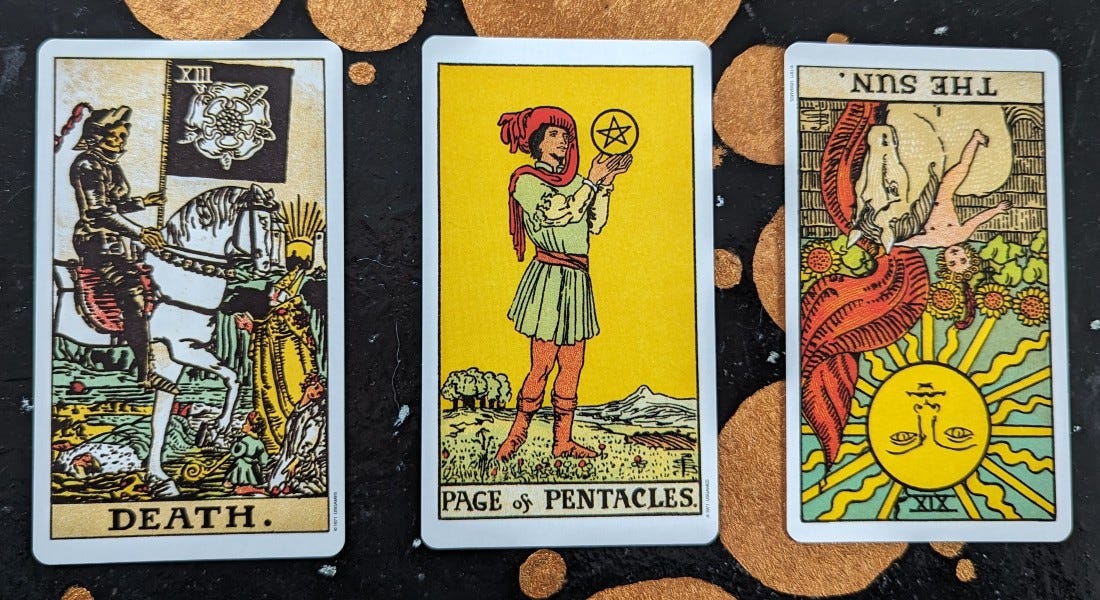
My situation: Death
One of the most notorious cards in the Tarot, Death is much misunderstood. It doesn’t (necessarily) mean that anyone is going to die; rather, it represents transformational change, a sweeping out of the old to make way for the new. This certainly describes my current situation. I’ve been re-evaluating my life for almost a year now, since moving out of my former marital home, and have been trying to figure out my way forward, with regard not only to work but also where I want to live. Having recently come through the Spring Equinox (a time for moving out of the dark and into the light) and Easter (a time of rebirth), it feels like an appropriately symbolic period to make plans for the future and, crucially, act on them. I have lots of ideas, and my energy now needs to be directed toward turning them into reality. A time of transformation, indeed.
A challenge: Page of Pentacles
The suit of Pentacles is concerned with the material (or earthy) aspects of life, and the Page represents a person who is in the initial stages of a creative venture. So this, for me, indicates new beginnings in the realm of work: laying the foundations for what I want to achieve longer term. Determination and focus are the key to success here: making plans and sticking to them rather than getting carried away by random wild ideas. The fact that this card has been drawn in the ‘challenge’ position suggests I am likely to be feeling scattered and distracted (true!), and I will need to ensure that I knuckle down and don’t get knocked off course if I am to turn my plans into reality.
A way forward: The Sun (reversed)
In its upright position, the Sun represents success, radiance and abundance, and I was a little disappointed that this card fell out of the deck upside down! In its reversed position it can mean either a lack of optimism or, conversely, over-optimism; in other words, I might either lose faith in my own abilities and question whether I’m really capable of everything I want to do, or I might become overly confident and pursue unrealistic goals, setting myself up for failure. This is a good example of how a card should be seen not as a prediction but as a heads-up: I need to be careful that I take an accurate measure of my abilities, to ensure that I can move forward confidently with realistic plans, thus maximising my chances of success.
In a nutshell: Now stop dreaming and get to work!
Well, that’s me told.
In future posts I hope to explore other tools that can be used in a similar way, such as the I-Ching and (a personal favourite) bibliomancy. And, of course, I’ll make every effort to report back on whether these insights have indeed led me to make the actual changes, rather than just sit around nodding and thinking about them…
I have 2 packs of tarot but haven't used them in about a year...I'm going to do a reading for the new lunar year now after reading this